Save Automatically & Invest Intentionally: The Order That Changes Everything
You set up your 401(k) contributions years ago. They go out of your paycheck automatically, before you even see the money. You’ve been doing this for years. And you’ve been telling yourself you’re saving for retirement.
You’re not saving. You’re investing. Automatically, often without much thought, into a market-linked account where the value can drop without you withdrawing a single dollar.
That distinction isn’t just semantic. It explains why so many high-earning, responsible people feel like they’re not making real financial traction even when they’re doing everything they were told to do.
I’ve worked with clients across this exact transition for years. And what Bruce Wehner and I talked through on the podcast this week gets to the root of it. Not which products to use. The order.
Save automatically. Invest intentionally. Get that order right and everything changes.
Podcast: Play in new window | Download (Duration: 1:02:29 — 71.5MB)
Subscribe: Apple Podcasts | Spotify | Android | Pandora | Youtube Music | RSS | More
Table of Contents
Key Takeaways
- Saving and investing are not the same thing. Saving has a dollar-value floor – your $100 stays $100. Investing doesn’t – the value can drop without you touching a cent. Most people have been calling one thing the other.
- The order you do them in determines your financial outcome. The default playbook is: invest automatically first, spend second, save whatever’s left. The wealthy do it in reverse: save automatically first, spend from what remains, invest intentionally from the surplus.
- Automatic 401(k) contributions are investing, not saving – and doing them without due diligence, in a market-linked account you don’t control, is a bet most people don’t realize they’re making.
- Automating saving is a cognitive strategy, not a cop-out. It removes a high-stakes decision from your mental queue, so your best thinking goes toward evaluating actual investments, where discernment genuinely matters.
- Interrupting the compounding curve is more costly than it looks. The exponential gains happen late in the cycle. Most people never get there because they restart the clock repeatedly by spending, redirecting, or skipping months.
- Intentional investing means deploying capital into things you understand, with control, sized to what you actually have, not automatically following historical performance into deals you don’t fully understand.
The Difference Between Saving and Investing (And Why Most People Get It Wrong)
Let’s start with a precise definition, because the confusion between these two things is where most of the problem lives.
Saving is placing money somewhere it cannot lose dollar value. If you put $100 into a savings vehicle, those $100 will be there when you come back. The amount won’t become $60 or $80 because of market conditions. You haven’t taken the money out. No one stole it. It’s just there, in full, because you put it there.
Investing is different. When you invest, you’re placing capital somewhere it has the potential to grow, but also to lose value. Not because you withdrew anything. Because the asset itself dropped. You can wake up to an account statement showing your $100 is worth $50, and that’s investing.
What About Inflation?
This is where people push back, and it’s a fair point. Inflation erodes the purchasing power of savings over time. That’s real.
But what often gets missed is that inflation erodes investments too. The same monetary forces that reduce what your saved dollars can buy are working on your invested dollars simultaneously. And an investment loss on top of inflation doesn’t solve the inflation problem. It doubles it.
Losing hundreds of thousands of dollars in a badly-timed deal isn’t an inflation hedge. It’s your money going backward at speed.
The distinction we’re drawing is about the dollar-value floor. Savings has one. Investing doesn’t. That’s it.
The Language Problem
The reason this gets so muddled is that the phrase “saving for retirement” has become the universal shorthand for 401(k) contributions, which are, by this definition, investing.
Money in market-linked funds can drop. It has dropped. For many people, it’s dropped dramatically at exactly the wrong moment. Calling that saving doesn’t make it safer. It just makes it harder to think clearly about what you’re actually doing.
Why the Default Financial Playbook Works Against You
Here’s how most working Americans handle their money, in order:
First, a payroll deduction flows automatically into a 401(k) or similar vehicle before the money arrives in their account. Then spending happens. Then, if anything is left at the end of the month, it might get saved. Maybe.
The sequence is: invest first, spend second, save whatever remains.
The problem isn’t the investing. It’s what that order produces in practice.
The Automatic Investing Trap
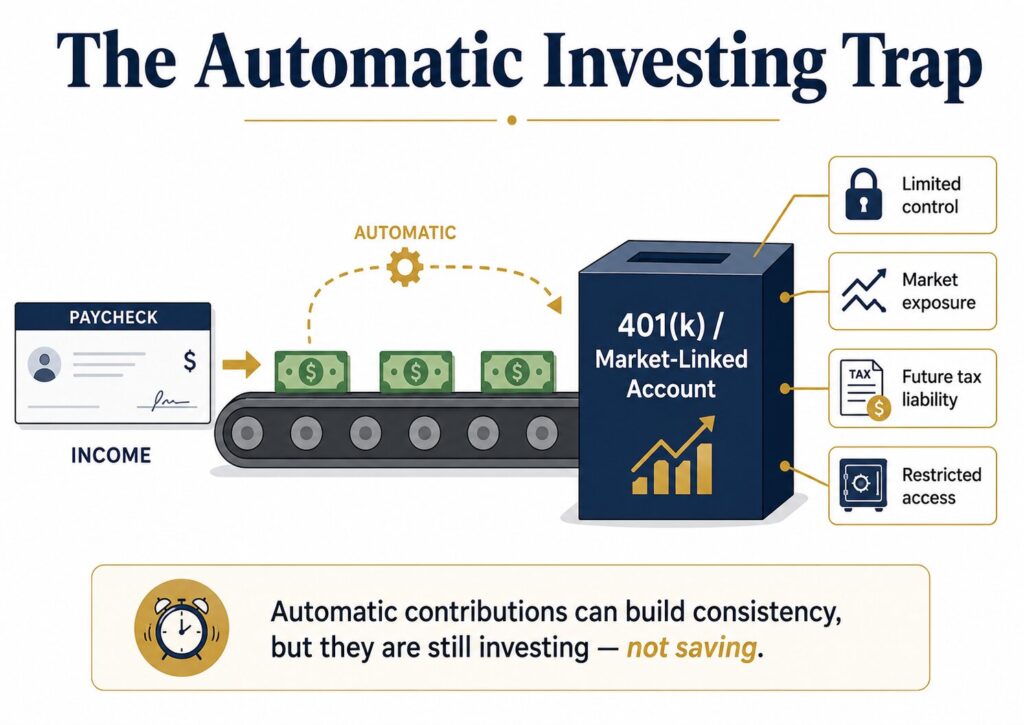
That first move, the automatic 401(k) contribution, is made without active due diligence, without specific knowledge of the underlying assets, and without meaningful control over timing or allocation. For most people, the decision is: pick a fund from a list, or accept the target date fund default. That’s it.
Target date funds are a genuine improvement over doing nothing. They diversify automatically and grow more conservative as you approach retirement. Financial advisors help take emotion out of the process, which matters more than most people realize. These are real improvements.
But they don’t solve the core problem. You’ve still lost control of that capital. You face future tax liability. And if you need access to it before retirement, the options are limited, costly, or both.
The Syndication Cautionary Tale
Bruce has been in over 6,000 client meetings. And one thing he’s seen play out repeatedly in recent years is what happens when the “must always be invested” mindset runs into a changing economic environment.
A lot of people deployed capital into real estate syndications because the historical performance looked strong and the tax benefits were real. What they didn’t fully evaluate was what happens when interest rates rise sharply, and when deals structured around balloon-payment loans need to be refinanced.
Rates went up. Sponsors couldn’t refinance. Distributions stopped. In many cases, that capital is effectively gone. Not because real estate is a bad investment category. Because people committed capital without evaluating the current monetary environment, and instead relied almost entirely on historical performance as their due diligence.
The people who pushed that money in because they felt they couldn’t afford to leave it sitting somewhere safe are the ones who lost. Their money didn’t just fail to outrun inflation. It evaporated.
The Savings Void
Because saving is residual in the default sequence, it often doesn’t happen at all. By the time spending is done, there’s nothing left to put aside.
And that’s the trap. When a genuinely good investment opportunity appears, there’s no capital ready to move on it. The people who can act are the ones who built up savings first – liquid, available, usable cash that’s safe and in their control. The others watch the opportunity pass.
How the Wealthy Reverse the Sequence
The pattern Bruce sees consistently across his wealthiest clients is the opposite of the default.
They save automatically first. They determine spending second. They invest intentionally from what remains. The order of priority is reversed, and everything that follows is different because of it.
The Personal Economic Model
Think of your money as moving through a system. Income arrives. Taxes come out. Then every dollar faces a decision.
The first and most important decision isn’t to save or invest. It’s: how much of this am I going to spend?
Spending less than 100% of what you earn is the prerequisite for everything else. It sounds basic, but it’s the step most people skip conceptually, even when they think they’re doing it.
The Richest Man in Babylon put it plainly: set thy purse to fattening.
A part of all that you earn is yours to keep. Mike Michalowicz made the same argument for businesses in Profit First. If you wait to see what’s left after spending, there won’t be anything left. There never is.
Once you’ve decided what you’re keeping, the next question is the order. Save first, spend from what remains, then invest intentionally from the surplus you’ve built.
The Client Who Saved His Way to Retirement
Bruce shared a story that most financial commentators would dismiss as a cautionary tale, but it’s actually the opposite.
One of his clients kept his 401(k) in a money market account for his entire career. Not in equities. Not chasing returns. A money market account. A lot of people would call that a waste.
He retired with close to $600,000 in that account.
Separately, he built cash-flowing investments, apartment complexes, in areas he understood thoroughly. He used capital he’d intentionally accumulated, deployed into deals he’d specifically evaluated, in a category he knew.
The money market account wasn’t his growth engine. It was his savings foundation. And it worked because he never confused it with something it wasn’t supposed to be.
Lifestyle Creep: The Silent Underminer
The flip side of the order switch is spending discipline.
Bruce’s clients who reach real financial freedom aren’t always the ones who made the most. They’re the ones who refused to let lifestyle expand every time income went up. Every pay raise that flows straight into a larger mortgage or a better car resets the savings curve.
A couple Bruce spoke to recently put it simply: they’re wealthy enough now that they don’t need to take risks. That perspective doesn’t appear by accident. It comes from years of not letting spending grow to fill income.
Why You Save Automatically, and What That Frees You to Do
Automating saving isn’t a passive move. It’s a deliberate cognitive strategy.
Humans have finite mental bandwidth. Every decision, large or small, draws on it. Mark Zuckerberg’s choice to wear the same clothes every day wasn’t a quirk. It was a calculated removal of a low-stakes decision so his best thinking could go toward things that actually mattered.
The Counterintuitive Logic
Most people assume you automate the things that are low priority, the things you’d forget or procrastinate otherwise. But the smarter argument is the reverse.
Automate the things that matter most. Make them frictionless. Make them happen before you have the opportunity to redirect that money toward something else.
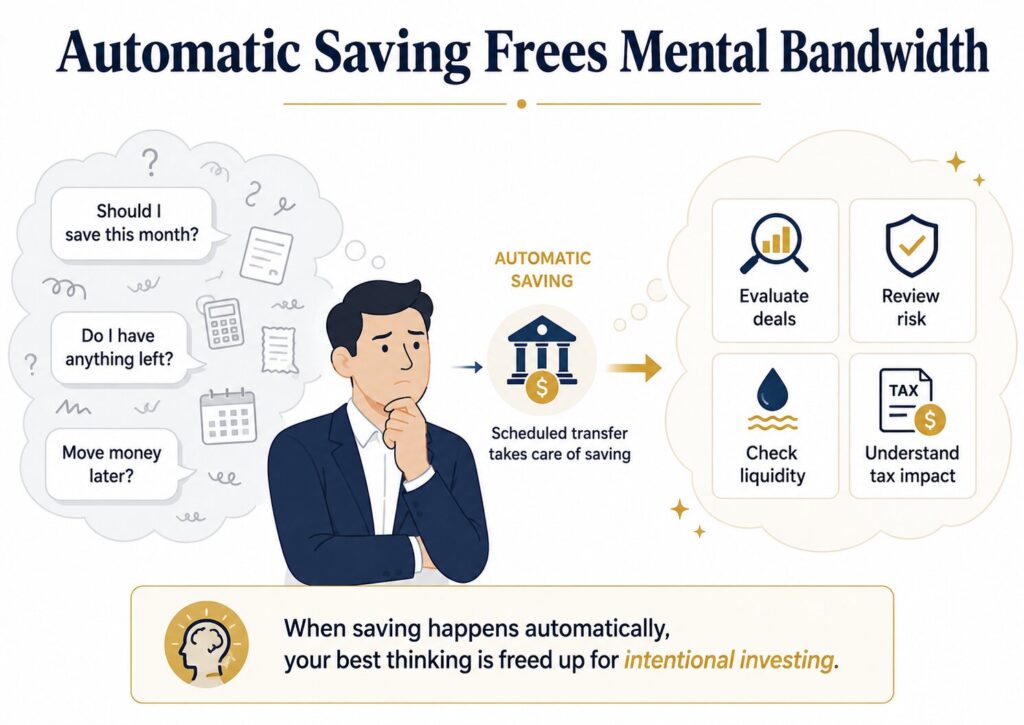
Saving is important enough to automate. An automatic bank draft that moves a fixed amount into savings at the start of every month isn’t a way to avoid thinking about money. It’s a way to guarantee the most important financial habit happens reliably, regardless of what else is going on.
What Gets Freed Up
Once saving is on autopilot, something shifts.
The mental energy that used to go toward the end-of-month question, “do I actually have anything left to save?”, is now available. And it can go somewhere more valuable: evaluating actual investments with genuine attention.
Not “is this opportunity available to me?” but “does this fit my criteria? Do I understand the risks in the current environment? Is this in an area I actually know?”
That’s the quality of thinking that produces better investment outcomes. Automatic saving creates the conditions for it.
Why Interrupting the Compounding Curve Costs More Than You Think
Bruce has a biology background, and he uses a petri dish analogy that makes the compounding argument land differently than a spreadsheet would.
A single-celled organism that doubles every cycle covers half a petri dish in 29 days. How long to cover the other half?
One day. Day 30.
The entire second half of the dish happens in a single cycle. Every cycle before it was necessary to get there. But the ones that feel slow, the early ones, are the ones people interrupt.
What Interruption Actually Costs
Every month where saving gets skipped because the money was already spent is a reset. You’re not starting from where you left off. You’re starting over, from the beginning of the compounding curve.
Most people never reach the steep part because they restart the clock repeatedly throughout their financial lives. They pull capital out. They redirect it. They spend the harvest and don’t replant. Then they wonder why it doesn’t compound.
Rachel’s image for this is a planted field. If you go out every few weeks and pull up the seeds because you can’t see a harvest yet, you’ll never get one. And if you do get a harvest and consume all of it rather than setting some aside to replant, there won’t be a larger harvest next year.
The behavioral patience required is real. Bruce is direct about this. The early years of automatic saving feel slow because they are slow. The compounding is happening beneath the surface, and it takes time to reach the part of the curve where it becomes visible.
The people who get there are the ones who didn’t interrupt it.
What It Means to Invest Intentionally, and How to Know If You Are
Intentional investing isn’t about finding better investments than the ones in your 401(k). It’s about a fundamentally different relationship with capital allocation.
Investor DNA
The starting point is knowing what kind of investor you actually are. Not what kind you’d like to be someday. What kind you are right now, based on your genuine knowledge, experience, and network.
Wealthy investors don’t ask “what investment might happen to work out?” They ask: what are my best investments? The ones where I have a real edge. The ones I can actually evaluate.
That means making sure every investment aligns with your specific criteria:
- Minimum investment amount – sized to the capital you actually have available, not what you wish you had
- Control and influence – the ability to evaluate the deal, direct it where possible, and exit if needed
- Sphere of knowledge – an area you genuinely understand, not just something that sounds good in a pitch deck
This is your investor DNA. The same capital deployed within it consistently produces better outcomes than the same capital scattered across diversified funds you don’t understand.
Real Due Diligence in the Current Environment
Historical performance is the laziest form of due diligence, and also the most common.
It tells you what happened under conditions that may no longer apply. Bruce’s point is blunt: the current debt-to-GDP ratio in the US has only been exceeded during World War II. That is not a historical norm. Making decisions based on historical norms in abnormal conditions produces abnormal losses.
Real due diligence means evaluating the monetary environment right now, the current taxation landscape, and the specific economic conditions that could affect how a deal is structured and whether it performs.
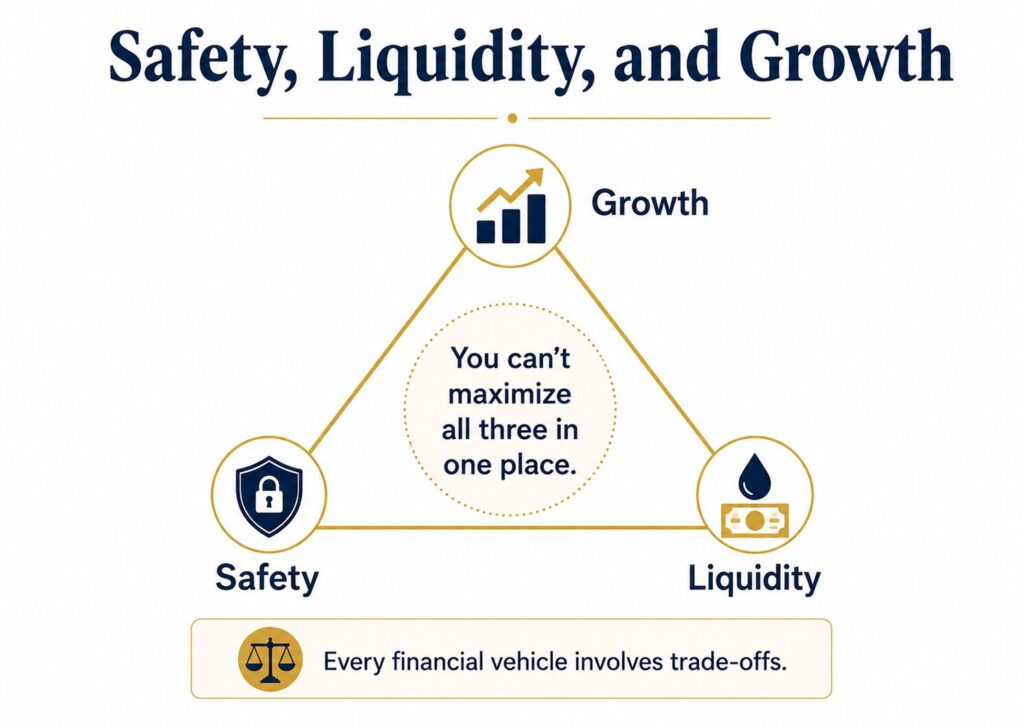
Safety, Liquidity, and Growth
Every place you put money should be evaluated through three lenses: how safe is it, how liquid is it, and what’s the potential for growth?
You can’t maximize all three in one place. That’s not a flaw in the investment. It’s the nature of capital. Recognizing the trade-off is what lets you make an honest decision about what you’re accepting and what you’re giving up.
Lack of liquidity isn’t automatically a problem. A five-year CD pays more than a one-year CD because the bank can make longer-term capital allocations with that money. The sponsor of a well-structured deal can do the same. Illiquidity can support stronger returns when you understand it going in and have accounted for it.
The Savings Vehicle That Bridges Both Stages
A properly designed whole life insurance policy fits this framework precisely, not as an investment alternative, but as a savings foundation.
By the definition we’ve been working with throughout this article, it qualifies as savings. The cash value that accumulates in a whole life policy will never drop in dollar value. It grows through guaranteed interest and non-guaranteed but highly anticipated and historically consistent dividends. The dollar amount in the policy statement doesn’t decrease.
How It Works in Practice
My husband and I use an automatic bank draft to accumulate premium payments throughout the year, then pay our whole life premiums annually. The cash value builds steadily. When an intentional investment opportunity comes up that fits our criteria, we have liquid capital to deploy from the policy using the Infinite Banking Concept. The process is automatic. The capital is there when it’s needed.
That’s the system working as it should. Save automatically into something safe and accessible. Invest intentionally from the surplus when the deal is right.
The Death Benefit Backstop
Bruce adds a dimension to this that doesn’t get talked about enough.
Even careful, intentional investors make mistakes. A bad deal can cost hundreds of thousands of dollars. The death benefit in a whole life policy, which is always larger than the cash value, can replenish that loss for your family when you die.
It doesn’t make bad investments acceptable. But it changes the risk profile of your overall financial system. You own and control this structure. The insurance company has built the infrastructure, the loan procedures, the compliance, and the people. You don’t have to build a bank. You just have to use one you control.
A couple of important points: not all whole life policies are designed for this purpose. The base to paid-up additions structure matters, and variable or indexed universal life products don’t carry the same guarantees. Work with an authorized IBC practitioner if this is the path you’re exploring.
Where Saving and Investing Fit in the Wealth Creator’s Cash Flow System
TMA’s Wealth Creator’s Cash Flow System maps cleanly onto what we’ve covered here.
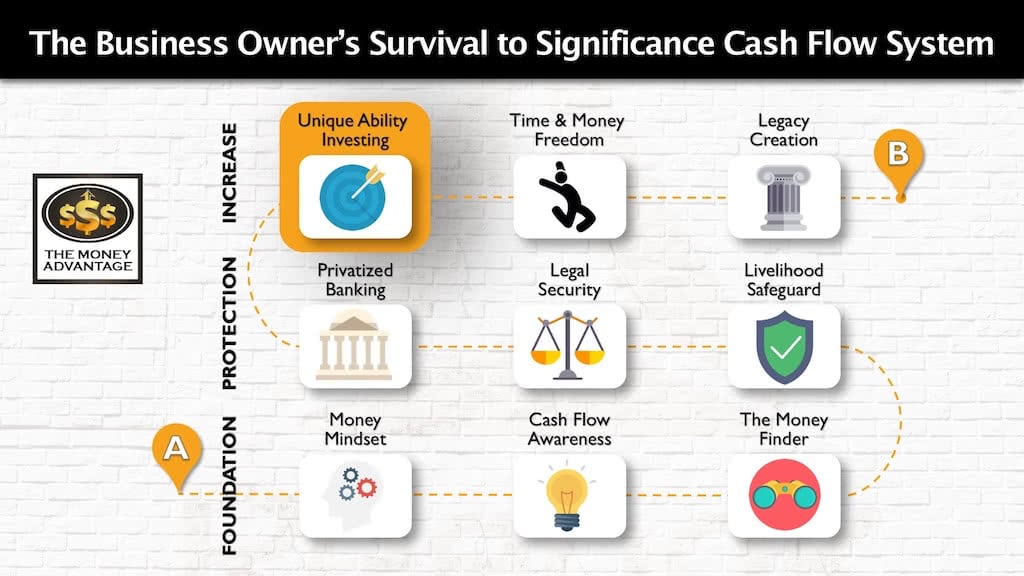
Foundation (Stage 1) is where the order switch happens. Getting saving before investing isn’t a product decision. It’s a behavioral one. It requires an automatic transfer and the discipline not to touch it. That’s it. Nothing to buy, no account to open. Just a priority decision.
Protection (Stage 2) is where a well-designed whole life policy earns its place. Once saving is automatic, the policy provides a protected capital base that doesn’t move with the market, stays accessible through policy loans, and keeps growing even when you borrow against it. That makes the whole system durable through downturns and investment mistakes.
Increase (Stage 3) is intentional investing, funded from the capital you’ve built in Stage 2. The money available for this stage isn’t trapped in a 401(k) you don’t control. It’s in a vehicle you own, accessible on your own terms, deployable when the right opportunity appears, and you’ve done the real work of evaluating it.
Change the Order, Change the Outcome
This isn’t an argument against investing. It’s not anti-401(k), anti-market, or pro-hoarding cash under a mattress.
It’s an argument for sequence.
The default financial playbook has most people investing automatically, spending next, and saving whatever happens to be left. That order exists for a reason. Americans don’t naturally set money aside in a consumer environment, and payroll deduction at least captures something before it gets spent. That’s a real problem being addressed, imperfectly, by the current default.
But you can do better.
When saving is automatic and protected, the capital base grows without interruption. When investing is intentional, the decisions are sharper. The due diligence is real. And you’re deploying from a position of strength, not scrambling to catch up.
The behavior change isn’t complicated. An automatic bank draft. A commitment not to redirect it. The patience to stay on the compounding curve long enough for it to matter.
What’s harder is the emotional resistance. The early years feel slow. It can feel like the automatic investing crowd is getting ahead while you’re just parking money somewhere safe. But the people who interrupt the curve rarely reach the steep part. And the ones who do are consistently the ones who saved first.
Book A Strategy Call
If you want to understand how this would look in your specific financial picture, how much to save automatically, what vehicle makes sense, and how to build the capital base for intentional investing, Book a Strategy Call.
Frequently Asked Questions
What is the difference between saving and investing?
Saving means placing money somewhere it cannot lose dollar value. Whatever amount you put in will be there when you come back, regardless of market conditions. Investing means placing money where it has the potential to grow, but also the genuine potential to lose value without you withdrawing a single dollar. The key distinction is whether there’s a dollar-value floor on what you’ve put in.
Why is automatic 401(k) investing not the same as saving for retirement?
Because the money in a 401(k) is invested in market-linked funds, where the value can and does drop. People use “saving for retirement” to describe these contributions, but the activity is investing. That’s not a criticism of the strategy. It’s a clarification of what’s actually happening so you can make clearer decisions about both.
How do I start saving automatically?
The simplest version is an automatic bank draft that moves a fixed amount into a separate savings account at the start of every month, before you spend anything. Putting it in an account at a different institution from your main bank adds a small friction that makes it harder to dip into. The amount matters less than the habit. Start with something that happens without a decision every month.
What does intentional investing actually mean?
It means investing in areas where you have genuine knowledge and some degree of control or influence over the outcome, with capital sized to what you actually have available, after completing due diligence on the current economic and monetary environment, not just historical performance. It’s the opposite of automatic: eyes open, criteria defined, deal evaluated specifically.
How does whole life insurance fit into saving automatically?
A properly designed whole life policy functions as a savings vehicle in the precise sense we’ve defined: the cash value will never drop in dollar value. It grows through guaranteed interest and consistent dividends. You can access it through a policy loan when an intentional investment opportunity arises, and it continues growing during the loan. For many people, it becomes the savings foundation that funds intentional investing in Stage 3.
Why do wealthy people save before they invest?
Because it’s the order that actually builds capital. Saving first means money is protected and growing uninterrupted, which is what allows compounding to reach its full effect. Investing first, before saving is established, means capital is at risk before there’s a protected base. Wealthy people tend to prioritize control and durability over maximum theoretical returns, and saving before investing is how you maintain both.

Boost Investment Returns with Infinite Banking
Every investor faces the same quiet trade-off. The moment you move capital from savings into a deal, the money stops growing where it was. It is now in the deal,or it is in the bank, but it is not doing both. That is the either/or trap of conventional investing, and almost nobody questions it. There…
How to Turn Savings Into Wealth: The System Most People Miss
The $15 Lunch That Quietly Steals the Future Bruce and I were talking recently about something that looks harmless on the surface—and yet it explains why so many people feel stuck. Bruce went to lunch and noticed groups of high school kids spending $15–$20 a day at a sit-down restaurant. Every day. And it hit…