
Why the Executive Bonus Plan Is the Ideal Golden Handcuffs
In today’s competitive hiring landscape, attracting and retaining quality talent requires more than a standard salary and benefits package.
The Executive Bonus Plan can be the ideal “golden handcuffs” for the top talent you can’t afford to lose. In truth, associating long-term dedicated employment with slavery seems a bit archaic and melodramatic. We all know you can’t keep good people by holding them hostage. Instead, you’ve got to set the table that attracts them and makes them want to stay.
That’s where an Executive Bonus Plan, specifically a 162 Executive Bonus Plan, becomes a strategic tool. It can help you serve up a scrumptious benefits package to find and keep the best people so your business can fulfill its mission. By offering life insurance-based compensation with long-term value, you give key employees a strong incentive to stick around without the rigidity of traditional deferred comp plans.
In today’s show, we’ll discuss options for a deferred compensation package and fringe benefits that create a win-win for the employer and the employee. We’ll also demonstrate how the Executive Bonus Plan is a recipe made with cash value life insurance policies. That makes it the perfect way to offer something of future value that they’ll have to – and want to – maintain employment to get.
Podcast: Play in new window | Download (Duration: 28:01 — 32.1MB)
Subscribe: Apple Podcasts | Spotify | Android | Pandora | Youtube Music | RSS | More
Table of contents
The Competition Today’s Employers Face
In a growing economy with declining unemployment rates, everyone is hiring, but few people are looking for work. So, employees, who have their pick of employers, are in a position of leverage. Because the pool of available labor is smaller, it costs more.
So, companies have steeper competition to get the best employees. They have to be willing to pay more, and often will have to do quite the song and dance to win them over. That means paying more or offering more benefits and perks.
Today’s job market is less about salary alone and more about what comes with it. Remote work, flexible schedules, and meaningful perks often outweigh a higher paycheck. Retention now hinges on how well an employer supports work-life balance, personal growth, and financial security.
The competition businesses face is compounded by the current mindset towards employment in general.
Company loyalty is a lower priority than personal advancement. Long gone are the days when people worked for one company their whole life. A good person needs to feel engaged, appreciated, rewarded, and fulfilled. If not, there’s little stopping them from leaving in search of another place of employment where they’ll thrive.
Fringe Benefits Help Employers Spend Less to Compete
That also means that businesses are the ones with the most at stake if good people leave. They could lose contracts, revenue, and momentum when their intellectual capital walks out the front door. And it could be difficult, time-consuming, and expensive to find a replacement.
Therefore, the onus is on business owners to create an employment dynamic that great people want to be a part of. Offering high-quality fringe benefits is one way that employers can extend the handshake that turns into the ideal kind of loyalty.
Fringe benefits also offer a smarter way to compete, without simply throwing more salary at the problem. A well-structured bonus plan tied to a life insurance policy can cost less than a raise while offering far more perceived value to the employee.
Employers must exert more effort upfront – and more dollars – to reach ideal candidates to fill their most important roles. And to keep them as long as possible.
In “HR speak,” this is attracting and retaining top talent.
Where the Executive Bonus Plan Fits into the Cash Flow System
Executive compensation and benefits are just one part of a bigger journey to building time and money freedom.
That’s why we have created the 3-step Business Owner’s Cash Flow System. It’s your roadmap to take you from just surviving financially to living a life of significance, purpose, and financial freedom.
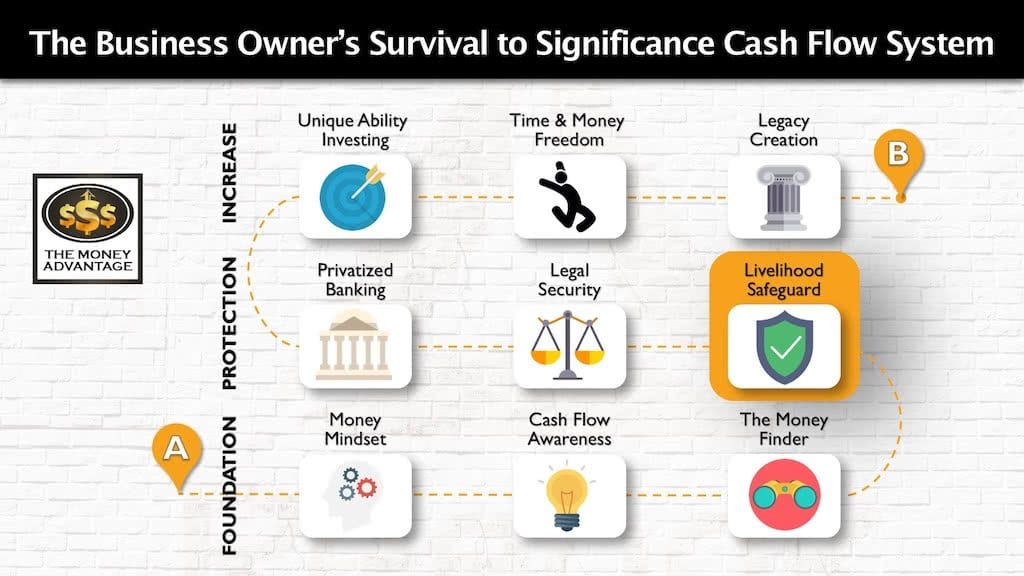
The first step is to keep more of the money you make by fixing money leaks. Then, you’ll protect your money with insurance, legal protection, and Privatized Banking. Finally, you’ll put your money to work, increasing your income with cash-flowing assets.
Executive Bonus Plans are part of Stage 2. They help you attract and retain key talent, drive down costs, and protect your business’s revenue production. They also support your long-term financial strategy by aligning your compensation model with both business goals and employee wealth-building.
While your employee benefits from tax-advantaged growth in a cash value policy, your business benefits from a stronger, more stable team.
If you utilize a Specially Designed Whole Life Insurance Policy, it can be a tool for Privatized Banking.
This protection also extends to Unique Ability Investing, as you secure the value of your business, one of your greatest assets.
Deferred Compensation
When you’re talking about benefits for the C-suite, most employers first think of deferred comp. It’s seen as a way to both help employees better prepare for retirement and incentivize loyalty by offering future benefits at the same time. Instead of paying everything in today’s salary, the business allocates a portion of pay to be delivered on a future date.
Deferred comp comes in two main varieties: qualified and non-qualified.
Qualified plans, like the 401(k), are often insufficient for execs, because contribution limits make them seem like a drop in the bucket. Not an enticing, high-quality benefit.
Non-qualified deferred compensation is more suitable for key executives and key employees.
The employer can pay into a defined benefit plan like Supplemental Executive Retirement Plans (SERPs).
Or, it can be set up as a deferred savings plan. In this case, the executive would defer compensation through a salary reduction arrangement or bonus deferral plan.
Stock options and profit-sharing agreements may also fall under non-qualified deferred comp, depending on how they’re structured.
Usually, there is a vesting schedule, so the employee would have to work a set number of years to receive the full benefit.
The Problems with Deferred Compensation for Execs
However, the main drawback is that the business doesn’t get an immediate tax deduction for the money it puts aside.
Also, the business needs reserves, an investment strategy, and often, life insurance to back the whole program.
Then, there’s a future liability to pay out benefits, layering on risk.
But the bigger issue is what it looks like from the employee’s side. The executive usually can’t touch the money until a specific future date, which is often years away. That means limited access and zero control.
The employer controls when, how, and under what conditions the money gets distributed. In many cases, that might include termination clauses or vesting hurdles that make the benefit feel uncertain.
And if the company goes under, that promised benefit could vanish entirely, since it’s still technically the employer’s asset until payout.Executive Bonus Plans solve the Problems of Deferred Compensation.
Executive Bonus Plans through life insurance solve the main problem by allowing the employer to get an immediate tax deduction on the money they pay in.
Here’s how it works:
What Is an Executive Bonus Plan?
While there are several types of bonus arrangements, the basic idea is the same: a company uses its own funds to reward a key employee through life insurance.
One of the most common versions is the 162 Executive Bonus Plan.
What is a 162 Executive Bonus Plan?
The Executive Bonus Plan is a way for you to provide permanent life insurance as employee benefits to attract, retain, and reward key employees.
It’s surprisingly simple to administer and use. The business purchases life insurance on the life of the executive.
As the policy payor, the employer can make premium payments directly or through a salary bonus. The executive, then, is the owner and insured of a personally-owned permanent life insurance policy.
Because these plans aren’t subject to ERISA guidelines, employers don’t need IRS approval, and there are no discrimination rules, so you can pick and choose who to reward. You even have the discretion to offer different bonuses to different executives.
You Both Win
Along with being simple to set up, the executive bonus plan offers some compelling tax perks for both the business and the employee.
For the employer, it’s a deductible expense under IRS Section 162. That means every dollar used to fund the policy can reduce taxable income, without the administrative burden of qualified plans.
It’s also a powerful retention tool. Employees are less likely to jump ship when they know their policy grows in value the longer they stay.
For the employee, they get full ownership of the policy.
That means access to tax-advantaged cash value growth and a permanent death benefit they can pass on to heirs. If the plan uses a whole life policy, it can even double as a private banking tool, giving them greater control over personal finances.
Let’s take a closer look at how the IRS treats these arrangements.
Tax Treatment

As the employer, you now have a desirable benefit to offer, and you get an immediate tax deduction, too.
Because the premium is considered additional compensation for the executive, you write it off as an ordinary and necessary business expense. This makes it tax-deductible to your business, giving you an immediate tax deduction on the money you pay in premiums today.
At the same time, the premium is considered additional compensation to your exec. The executive pays income tax on the amount in the same year, just like they would on any other cash bonus payments they receive.
Lower Risk
Because the insurance company provides the policy values, your responsibility ends with the premium payment. You’ve defined your contribution and left the benefit up to the insurance provider. That means you don’t have a future liability to pay, so you’re in a safer financial position.
This is a key difference from company-owned deferred comp plans, where future payouts remain on the books as liabilities. Executive bonus plan life insurance doesn’t burden the balance sheet, and there’s no need to manage long-term reserves or investment performance. It’s simple, clean, and predictable for the employer.
Cash Value Benefits for Your Executive
And with the Executive Bonus Plan, your best talent wins, too.
Because your employee owns the policy, they have ownership and use rights. That means that they choose the beneficiary who will receive the death benefit proceeds.
They get tax-deferred policy cash value growth and income-tax-free life insurance loans as long as the life insurance policy stays in force and doesn’t become a modified endowment contract.
That means that they gain access to use the policy’s cash value via withdrawals and income-tax-free loans, for anything, including buying a house, a boat, a vacation, or paying for kids’ college, or supplemental retirement income.
(The amount of cash surrender value they have in the policy is based on their age and health when the policy began, and how long they’ve been paying policy premiums.)
Policy ownership comes with an income-tax-free death benefit. So, you’re also giving them immediate peace of mind that their loved ones will be taken care of.
This turns the executive bonus plan into far more than just a perk, as it becomes a private wealth-building vehicle. With time, the cash value can offer flexibility, liquidity, and long-term security that traditional benefits simply don’t match.
The Downside of Executive Bonus Plans
But, just as Executive Bonus Plans solve the main problems of deferred compensation, they create another.
Without adding a legal agreement, you incur the following problems. But stay with us as we show you a solution for that too.
You forfeit control over the bonus once you’ve paid for the insurance premiums. So, if you were hoping for benefits that your employee would need to stay with you to get, this wouldn’t automatically suffice.
That’s because the executive gets the ownership benefit right away. If they quit, they’d take the life policy with them. That means they wouldn’t lose out on any of the benefits of the bonuses they’ve already received.
Sure, you wouldn’t continue funding future premiums, so the life insurance values wouldn’t continue to grow as illustrated. And maybe that’s enough incentive to stay.
But it doesn’t require loyalty or tenure to use the bonus that’s already been paid.
Also, compared to inexpensive term coverage, whole life policies have higher upfront costs, which may feel steep in the short term, even if they deliver greater long-term value.
Finally, the employee is taxed on the bonus amount in the year it’s received. That creates an immediate tax burden, unless you opt for a double bonus to help cover the taxes.
How Executive Bonus Plans Can Be the Ideal Golden Handcuffs
Executive Bonus Plans aren’t a one-size-fits-all proposition.
Instead, there are plenty of design options to completely customize the benefit. This flexibility makes an Executive Bonus Plan that much sweeter.
As the employer, you can’t own the policy, be the beneficiary, or have the right to cancel the policy.
However, just about anything else is fair game, so long as all parties agree at the beginning. And, it’s essential to set up a written legal agreement with an excellent attorney to lay out the terms of the bonus.
One popular option is a Restrictive Endorsement Bonus Arrangement (REBA), where the employer controls access to the policy’s cash value or limits when the executive can exercise full ownership rights. In essence, it ties benefits to a vesting schedule or other milestones.
Other strategies include adding a split-dollar agreement or inserting a retention clause that provides greater benefits the longer the executive stays.
While these legal structures support the “golden handcuff” aspect, don’t underestimate the power of emotional loyalty.
When someone owns a life insurance policy that can help them build wealth, protect their family, and fund personal goals, they see it as more than a job perk — it almost becomes a little personal. That kind of emotional buy-in is hard to walk away from.
Custodial Executive Bonus
You can modify the plan to meet your needs with a wide range of special provisions.
Most notably, you can limit how your executive gets to use the policy. And that puts you in control.
Employer controls are added with a Custodial Executive Bonus, also known as a Restricted Executive Bonus Plan.
One way to do this is by requiring employer consent for your employee to access their cash values. This gives you veto power over the timing or purpose of their request. This could be especially valuable to you if you were concerned that your exec may leave your company and use their cash value to start a competing business.
To set up a deferred benefit, you could require your employee to satisfy a length of service or wait until a stated retirement age before they can use the cash value. This would prevent the employee from using and accessing the benefit in the future.
Another option would be to add a vesting schedule and forfeiture language. This would cause them to lose some of the benefits if they leave you before being fully vested.
Or you could require them to reimburse you for premiums paid if they leave you before a specific date.
The Flexibility of Executive Bonus Plans
To sweeten the pot and make the benefits to the professional even more incentivizing, you can add in a double bonus. In this case, you would pay the life insurance premiums and the corresponding income tax your employee will owe in that year.
Another option is to add an executive contribution provision. This would allow your employee to add premiums on top of what you pay in. This would build up a larger policy, with higher cash values and death benefits.
Plans can be tailored by role or seniority, offering more generous bonuses to your top talent.
They also adapt to your company’s stage, from lean startup to growing enterprise, without requiring rigid structures or approvals.
Solving the Most Problems with One Policy
To get the most out of one policy, you could initiate a Key Man Life Insurance policy that later converts to an Executive Bonus Plan. Additionally, a policy set up as an Executive Bonus Plan could then be used in a one-way Buy-Sell Agreement where the key employee buys out the existing business owner.
You’d start a policy that insures your executive.
At the start, your business would be the owner and beneficiary, so that you have the financial protection against losing your top executive. (Premiums would not be a tax deduction to the business in this case.)
Then, that same policy would transfer ownership to the employee at a later date. This would put you, the business, in the position to own and use the cash value upfront, and promise the use of the benefit to your employee later.
You gain employer control by deferring the benefit.
The advantage to your exec will be even higher policy values when they receive ownership because the policy will have more years under its belt.
Executive Bonus Plans and Infinite Banking
An additional strength of Executive Bonus Plans is that they can be a storage house for the Infinite Banking Concept.
In our opinion, the best type of policy you could use would be Specially Designed Whole Life Insurance.
If you use a Specially Designed Whole Life Insurance policy, the policy owner will have access to the guaranteed cash value that can serve as reserves.
That means that if the policy is initially set up as a Key Man policy, with employer ownership, the business gets the added benefit of using the cash value as an emergency/opportunity fund.
And if the life insurance policy is an Executive Bonus Plan, owned by the key employee, they gain the benefit of stable, predictable reserves.
Infinite Banking is a platform to get high early cash value and long-term growth. Since you earn returns in two places at the same time, you’ve given your top talent a gift within a gift. The bonus isn’t just one-dimensional money. It’s some of the hardest-working dollars that will benefit their lives by serving as a foundation for their wealth creation.
Getting Started with an Executive Bonus Plan
If you want to enhance your business’s executive benefits, and competitive ability to find and keep great people, an Executive Bonus Plan may be your ideal solution.
To get started, you would need the names, gender, and date of birth for the vital executives you want to reward. Determine your desired coverage amount or premium allocation, and identify the tax brackets applicable to your business and individual executives.
It also helps to clarify what you’re trying to accomplish – retention, tax planning, loyalty, or all three – so the plan design fits your business goals.
Armed with this information, you’re ready to book a call with our advisor team. We’ll help you navigate your need to deliver attractive fringe benefits. From policy design to carrier selection, our process ensures your plan fits both the people and the company behind it.
You’ll also find out the one next thing you need to do on your path to accelerate time and money freedom.
Book a Strategy Call: Build Retention and Loyalty That Lasts
Ready to compete for top talent without breaking the compensation budget? Book your free strategy call today to see how an Executive Bonus Plan can reward your team and strengthen your business.


When Can You Start Using a Whole Life Policy? The Truth About Policy Loans
A properly designed whole life policy can make a policy loan available surprisingly early. Rachel and Bruce explain how policy loans actually work, what you are really borrowing against, and why how soon you can borrow is the wrong question to design a policy around.

Whole Life Insurance vs. Annuities: Why Whole Life Can Be the Stronger Foundation While You’re Still Building Wealth
When people ask whether whole life insurance or an annuity is better, I think there is a more useful place to begin. Instead of starting with the product, start with the job you need your money to do. Are you looking for income you cannot outlive, access to capital to grow a business, more certainty…