
Whole Life Dividends Explained: What They Are – and What They Are Not
When most people hear “dividend,” their brain goes straight to stocks. That’s understandable. And completely wrong when applied to whole life insurance.
That one assumption causes real problems. People chase companies with the highest declared dividend rate. They compare illustrations side by side and pick the bigger number. They make decisions based on a metric that, on its own, tells them almost nothing about how their policy will actually perform.
This article gives you a clear picture of what whole life dividends actually are, what they’re not, and what really determines whether your policy works for you over the long run. The conclusion is probably not what you’d expect: the most important factor isn’t the dividend rate, the company, or even the policy design.
It’s your own behavior.For a deep dive into how dividends are calculated and the four biggest myths about dividend rates, see our earlier conversation with Perry Miller here.
Podcast: Play in new window | Download (Duration: 57:33 — 65.9MB)
Subscribe: Apple Podcasts | Spotify | Android | Pandora | Youtube Music | RSS | More
Table of Contents
Key Takeaways
- Dividends are return of excess premium. What happens between your payment and your dividend is capital management, not a refund.
- A 6% declared rate does not mean 6% cash value growth. Actual growth depends on Age, base-to-PUA ratio, and other policy design options. Loan activity can also affect results with direct recognition companies.
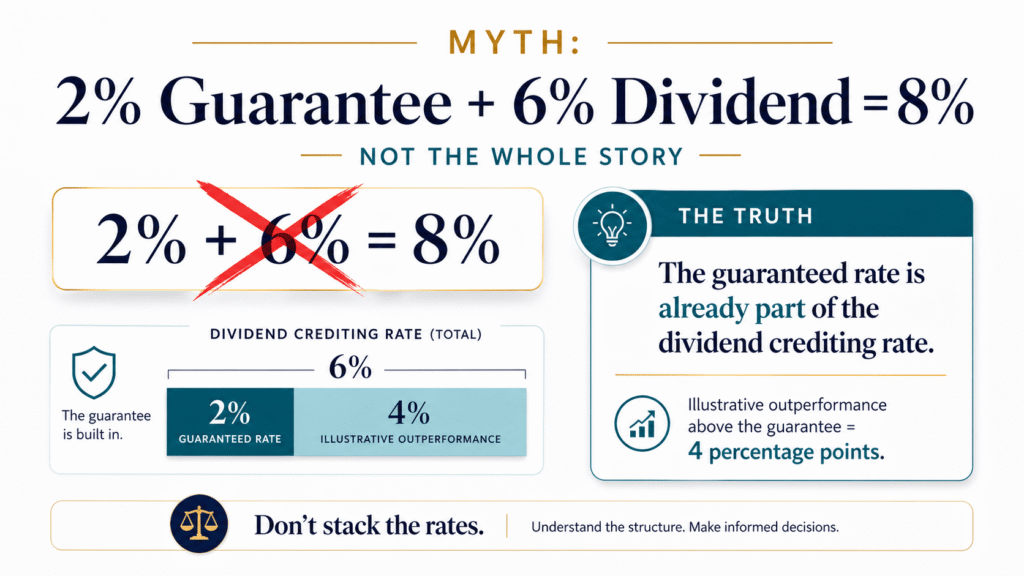
- The guaranteed interest rate is not separate but makes up part of the declared dividend. 2% guarantee plus 6% dividend does not equal 8%.
- Younger policyholders get less of the dividend pool. Older policyholders get more. Endowment math.
- Base premium gets higher crediting than PUAs because the company can count on it.
- Never compare direct and non-direct recognition illustrations without modeling loan activity in both.
- Your behavior matters more than the rate, the company, or the design.
What Whole Life Dividends Actually Are
For tax purposes, the IRS classifies whole life dividends as a return of excess premium. That label gets used against whole life all the time. “See? They’re just giving your money back.”
It’s not. If you paid $500,000 into a policy over twenty years and now you have $1.7 million in cash value, nobody just gave your money back. You have far more than you paid in.
How the Money Actually Moves
Insurance companies are extremely conservative in their projections. They overestimate mortality costs, overestimate expenses, and lowball what their investment portfolio will return. That’s deliberate. It protects your money for the long run.
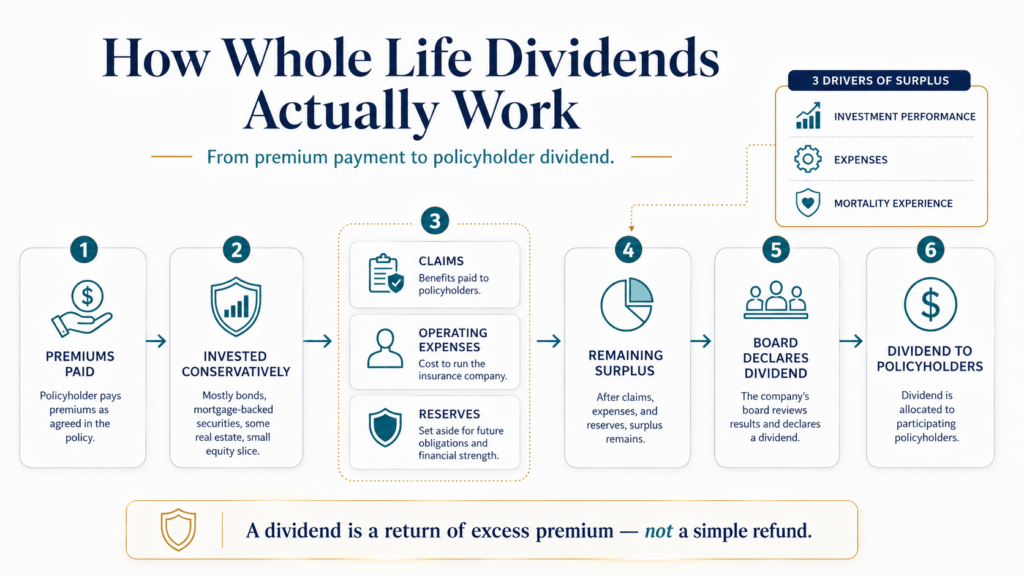
The CIO deploys premiums into a portfolio that’s roughly 75 to 85 percent fixed income: bonds, mortgage-backed securities, and some real estate. A small sliver sits in equities. The company pays death benefit claims, pays operating expenses, and sets aside money into reserves. Then the board declares how much of the remaining surplus goes back to policyholders.
Three factors drive that surplus: investment performance against projections, operating expenses against budget, and actual mortality experience against actuarial estimates. Beat expectations on any of those, and policyholders share in it.
Not Guaranteed, but Highly Probable
Dividends sit outside the contractual promises; unlike the death benefit, the cash value growth, and the level premium, they’re not guaranteed. But mutual companies have paid them consistently for over 100 years. Through recessions. World wars. The 2008 crisis. A decade of near-zero rates. They adjusted downward. They didn’t vanish.
The Coca-Cola Analogy
Coca-Cola has excess profits because they charge more per can than they need to. That’s how they fund dividends to shareholders. A mutual insurance company works the same way. It prices conservatively, manages capital, and returns the surplus.
But here’s the difference. As a policyholder of a mutual company, you’re not just a customer. You’re a part-owner. You participate in your company’s profits.
What Whole Life Dividends Are Not
Not Stock Dividends
Stock dividends are volatile, taxable in the year received, and are subject to cuts or elimination in a bad year based on economic factors that swing wildly.
Whole life dividends from mutual companies are non-taxable (classified as return of premium), built on actuarial science rather than market speculation, and backed by a stability track record that equity dividends simply can’t match.
Even during the financial crisis of 2008, when bond rates dropped and stayed down for over a decade, mutual companies adjusted their dividend rates. They didn’t collapse. They didn’t plummet to near zero. They adjusted.
Not a Simple Interest Rate on Your Cash Value
This is the misconception that causes the most confusion. If a company declares a 6% dividend, that does not mean your cash value grows by 6% that year.
You can’t just take 6% and apply it to your current cash value. There’s a list of reasons why. That declared rate is gross, before administrative fees, before mortality costs, and before the actuarial mechanics that make your policy endow at age 120 or 121. The actual impact on any individual policy depends on the policyholder’s age, the ratio of base premium to PUAs, other policy design options. Additionally, if with a direct recongnition company, whether there are outstanding loans.
Same rate but very different outcome depending on who you are and what you’re doing with the policy.
Not in Addition to the Guaranteed Interest Rate
This trips people up constantly. They see a guaranteed interest rate of 2% and a declared dividend of 6% and assume they’re getting 8% growth.
That’s not how it works. The guaranteed rate is already inside the dividend. The company guarantees it can make at least 2%. If it earns enough to support a 6% crediting rate, the additional performance above the 2% floor is what generates the dividend.
So the real outperformance is 4 percentage points and not 6 stacked on top of two.
How Dividends Are Actually Allocated to Your Policy
This is the part that goes beyond what most dividend conversations cover. And it matters if you want to understand what your dividend actually means for your specific policy.
The Endowment Requirement
Every whole life policy is contractually engineered to endow at age 120 or 121. That means your cash value and your death benefit will be equal at that point. This isn’t a footnote buried in the contract.
It’s the mathematical engine driving how dividends get allocated. The company has to make sure every policy’s cash value reaches the death benefit by that endowment date, regardless of what the markets do along the way.
Why Younger Policyholders Get a Smaller Share
Contrast a 20-year-old and a 60-year-old. Both paying $10,000 per year into a whole life policy. The same premium and the same declared dividend rate.
They receive very different dividend credits.
The 20-year-old has 100 years until endowment. That cash value has an enormous runway to compound. Less dividend is needed today because time does the heavy lifting.
The 60-year-old has only 60 years. Their cash value needs a bigger share of the dividend pool to close the gap between cash value and death benefit faster.
Same rate but a very different allocation. And it’s not unfair. It’s contractual. The policy promises to endow at a specific age, and the actuarial math allocates accordingly.
Why Base Premium Gets Higher Crediting Than PUAs
Base premium is the portion you’re contractually obligated to pay every year. The company knows it’s coming. The CIO can plan investment decisions around that certainty and deploy capital with confidence.
Paid-up additions are optional. You don’t have to pay them. The Chief Investment Officer can’t rely on PUA contributions the same way when making long-term decisions.
There’s a second factor too, with base premium, the death benefit relative to the premium amount is much higher.
A policyholder paying $100,000 in base premium might carry a death benefit of $800,000 or $1 million. That cash value has to close a gap of $700,000 to $900,000 by endowment.
But $100,000 of PUA premium might only buy $200,000 of death benefit, because it’s already paid up. It only needs to grow by $100,000 over the same period.
So the dividend has to work harder on the base side. More crediting goes there, especially in the first 20 to 30 years. If someone funds PUAs religiously for three decades and the PUA’s death benefit grows to exceed the base death benefit, the crediting can equalize. But until then, base drives the dividend engine.
The Direct vs. Non-Direct Recognition Distinction
A non-direct recognition company credits the same dividend whether you’ve borrowed against the policy or not. Loan activity doesn’t affect your dividend.
A direct recognition company reduces crediting on the portion of cash value you’ve loaned against. Your cash value grows differently depending on whether you have a loan or not.
Here’s where it gets misleading. Someone comparing illustrations might see the direct recognition company projecting a higher cash value over 30 years and pick that one. But the moment they take a policy loan, that illustration is no longer valid. The crediting on the loaned portion drops. The comparison falls apart.
Non-direct recognition companies often carry a slightly lower base rate because they’re pricing in consistent crediting regardless of loans. Direct recognition companies sometimes include catch-up provisions where, after 10 or 15 years, the loan rate and crediting rate equalize. Neither is universally better.
But you should never compare illustrations without modeling the same loan activity in both. Without that context, the numbers don’t mean anything.
Why the Dividend Rate Is the Wrong Thing to Compare
Insurance companies are in business, so they’re going to present their dividend in the best possible light. That’s not deceptive, it’s marketing. But you need to understand what you’re actually comparing.
Some companies advertise their dividend crediting rate. “We’re paying 6% this year.” Others advertise total dividend volume. “We paid $210 million in dividends to policyholders.” Each company picks the metric that makes them look best.
A large company might lead with volume because $210 million sounds impressive, even if their rate isn’t the highest. A smaller company might lead with rate because their volume, maybe $50 or $60 million, doesn’t carry the same weight.
Then there’s the cherry-picked time window problem. One company advertises that they’ve maintained or increased their dividend for 15 consecutive years. Another shows six years of increases and doesn’t mention the nine years before that.
Both pieces are technically accurate and deliberately selective. Actuarial products are designed over 100-year horizons. Evaluating them over six or fifteen years tells you almost nothing.
And here’s the thing about illustrations: the one thing we know for certain is that the illustration will not be correct. It takes today’s dividend rate and projects it out to age 121 with no changes. No increases. No decreases. Everyone knows that’s not how it will play out. The illustration is a planning tool, not a promise.
So what actually matters when selecting a company?
- Financial strength ratings.
- A track record of fulfilling contractual guarantees.
- Support for Infinite Banking practitioners and alignment with the Nelson Nash Institute. Not the current declared dividend rate.
The Factor That Matters More Than Any of This: Your Own Behavior
Here’s the core point, and it’s the reason this article exists.
Policyholder behavior has more impact on how a whole life policy performs than the dividend rate, the company selected, or the base-to-PUA design ratio. All of that other stuff is ancillary to whether you actually behave like a banker.
Why Premium Consistency Matters
When premiums lapse, the policy has to fund itself from cash value. The dividend can no longer compound on top of incoming premium. And if you have policy loans outstanding at the same time, you’ve got a real problem.
The loan balance compounds at interest. If the dividend isn’t growing faster than the loan balance because your base is too small and no new premium is coming in, the loan starts winning that race.
Eventually, if the policy can no longer support the loan, the company will require corrective action such as paying in additional premium, repaying part of the loan, paying loan interest out of pocket, or surrendering PUAs to cover the loan. Either way, you’re interrupting the compounding that makes the whole system work.
Why Loan Repayment Matters Just as Much
Policy loans compound, and if you borrow and don’t repay, that loan grows. Nelson Nash himself made this point over and over: you have to think and act like a banker. That means taking repayment of your own loans as seriously as you’d take repayment to any other lender.
The Bottom Line on Behavior
Someone who is disciplined about premiums and loan repayment will do well with a reasonably designed policy at a reputable mutual company. Regardless of whether that company has the highest declared dividend today.
Someone who isn’t disciplined will underperform regardless of which company they chose or how impressive the illustration looked.
You’re not just buying a product. You’re building financial infrastructure. And infrastructure requires maintenance. The maintenance here is behavioral.
How to Use Your Dividends Strategically
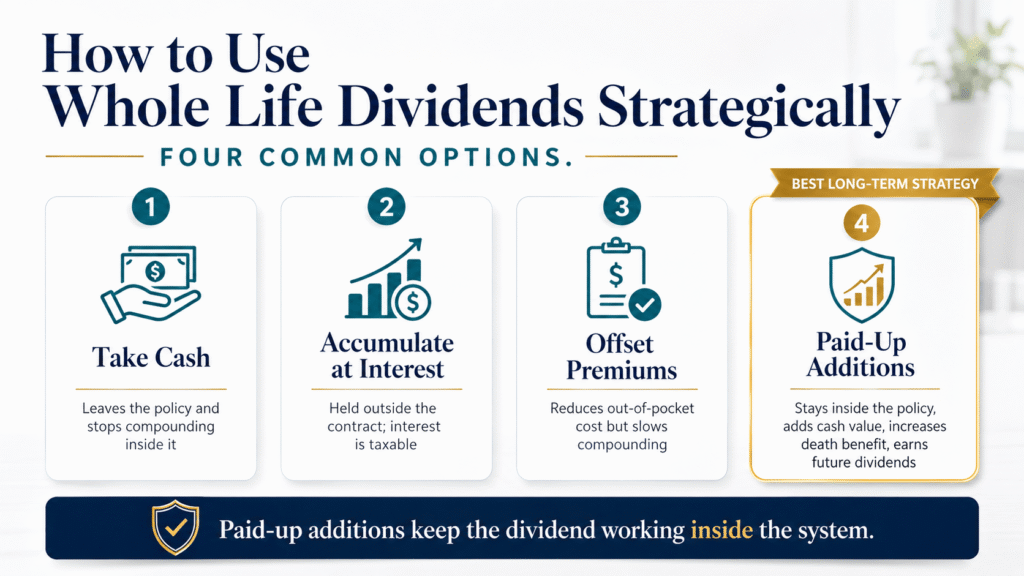
You have several options for how dividends are applied.
Taking dividends as cash. The company sends you a check. You can do this contractually. But once that dividend leaves the contract, it can no longer compound inside the policy. It’s gone. We never suggest this approach.
Accumulating dividends at interest outside the contract. Some companies offer to hold your dividends and pay you an interest rate, almost like a savings account. The problem is that the interest is taxable because it’s earned outside the insurance contract. You lose the tax treatment that makes dividends valuable.
Using dividends to offset premiums. This reduces your out-of-pocket cost, and there are seasons of life where that matters. But it slows compounding inside the policy. Not ideal as a long-term strategy.
Paid-up additions. This is the move. Taking dividends as paid-up additions keeps them inside the contract. They add to your cash value, increase your death benefit, and become eligible for future dividends. Compounding on compounding.
It also pushes the death benefit further away from the cash value. That forces the policy’s internal mechanics to work harder to close the gap by endowment. Which accelerates cash value growth. That’s exactly what you want.
Stop Chasing the Rate. Start Building the System
Whole life dividends are real, meaningful, and Worth understanding. But they’re not the scorecard that determines whether your policy performs well for you. That scorecard is your behavior.
Three questions matter more than any dividend rate when you’re evaluating a whole life company for Infinite Banking.
Is it a financially strong mutual company with a long track record of fulfilling its promises? Does it support Infinite Banking practitioners and align with the Nelson Nash Institute? Am I working with an authorized practitioner who designs for cash value rather than a death benefit?
If the answer to those three questions is yes, you’re in a strong position. The rest comes down to you.
Book a Strategy Call
We offer two powerful ways to help you take the next step:
Financial Strategy Call – If you’re evaluating whole life companies, comparing dividend rates, or trying to understand how Privatized Banking fits into your financial picture, this is where to start.
We’ll look at your specific situation and show you how to build a system around consistent premium funding, strategic loan use, and long-term cash value growth. Book a Financial Strategy Call with our team today.
Legacy Strategy Call – If you’re thinking beyond your own financial life and want to build something your family can steward for generations, we can help you uncover your family values, define your mission, and create a financial legacy that’s about more than just money. Book a Legacy Strategy Call to learn how we can help.
Frequently Asked Questions
What are whole life insurance dividends?
Whole life dividends are a return of excess premium from a mutual insurance company to its policyholders. The company collects premiums, invests conservatively, pays mortality costs and operating expenses, sets aside reserves, and returns any remaining surplus as a dividend. They’re classified differently from stock dividends and are not taxable as income.
Are whole life dividends guaranteed?
No. Dividends sit outside the policy’s contractual guarantees. What is guaranteed is your death benefit, your cash value growth, and your level premium. But mutual companies have paid dividends consistently for over a century, through world wars, recessions, and financial crises. The rates adjust. They don’t disappear.
How are whole life dividends different from stock dividends?
Stock dividends come from company profits, are taxable in the year received, and can be slashed or eliminated during downturns. Whole life dividends are a return of excess premium, non-taxable, and grounded in actuarial science rather than market performance. The stability difference is significant.
Does a higher dividend rate mean a better whole life policy?
No. A higher rate today doesn’t guarantee better performance tomorrow. Companies calculate and advertise dividends differently. Some lead with rate. Others lead with volume. And the illustration projects today’s rate to age 121 with no changes, which everyone knows won’t happen. Policyholder behavior, company financial strength, and policy design all matter more.
What is the best way to use whole life dividends?
For Infinite Banking practitioners, taking dividends as paid-up additions is the best approach. It keeps the dividend inside the contract, adds to cash value, increases the death benefit, and makes those additions eligible for future dividends. That’s the compounding-on-compounding effect that makes a well-managed whole life policy powerful over time.
What is direct vs. non-direct recognition in whole life insurance?
Direct recognition companies reduce dividend crediting on the portion of cash value that’s been loaned against. Non-direct recognition companies credit the same dividend regardless of outstanding loans. If you plan to use policy loans, and that’s the entire point of Infinite Banking, this distinction affects how your policy performs. Never compare illustrations from the two types without modeling the same loan activity in both.


What Happens to Cash Value When You Die? Why It Is Not a Separate Payout
What happens to cash value when you die? Learn why beneficiaries receive the death benefit, not two separate payouts, and how policy loans affect it.

How Whole Life Cash Value Grows Year by Year
See how whole life cash value grows year by year, why early values can be lower, how guarantees and dividends differ, and what break-even really means.